Barnes to Hammersmith Loop

Route details
Distance: 5 miles / 8 km
Terrain: Flat and easy
Route checked: May 2026
Duration 1hr 45 (easy pace)
Toilets: Yes
Refreshments available: Yes
Public transport assessable: Yes
Parking: Yes (paid)
Date visited 18th May 2026

A gentle, peaceful riverside walk with wildlife, hidden alleyways and plenty of opportunities for coffee stops.
Starting at Barnes Station, taking you to Hammersmith Bridge before looping back to Barnes. The route is mostly off-road and offers an abundance of wildlife, flora and fauna along the way.
Start at Barnes Station and exit via Platform 1.

Barnes Station opened on 27 July 1846 and is a historic Grade II listed railway station.
Take the alleyway on the left towards Vine Road Recreation Ground. Follow the alley with the cricket ground on your right until you reach the railway crossings. Walk through the first crossing and enter Vine Road Recreation Ground. At the entrance, there are public toilets and a coffee shop with outdoor seating, although opening times vary depending on the season.

The two Vine Road level crossings in Barnes, London, are quite unique. They straddle either side of the Vine Road Recreation Ground, creating an "island" of parkland completely boxed in by railway lines.
Walk through the park, keeping the railway track on your right, and exit at the far end. Continue through the alleyway and, at the junction, take the right-hand path under the bridge. At the end of Railway Side, turn right onto Beverley Walk, cross the road and take the alleyway leading to Willow Avenue.

Barnes, together with Mortlake, has many alleyways and passages, many dating back to the days of river trade when access routes to the Thames were essential. During the residential expansion of the 1860s and 1870s, further passages were added between the new terraces of workers’ cottages.
At the end of the alley on Willow Avenue, you will come across Beverley Works, a former aeroplane parts factory.

Originally opened in 1904 as a sawmill, the site later had several industrial uses. Between 1923 and 1930 it produced the Beverley-Brook sports car. During the Second World War it manufactured aeroplane parts and suffered significant bomb damage in 1940, affecting both the factory and surrounding homes. Beverley Works continued producing aircraft parts until closing in 1971 and is now a residential care home.
Walk along Willow Avenue, keeping Beverley Brook on your right. If you are lucky, you may spot the resident heron fishing in the brook.

Beverley Brook is a nine-mile tributary of the Thames, beginning near Morden before joining the river at Barn Elms. Its name comes from the word “Beferithi”, meaning “Beaver’s Ley”. Although beavers no longer live here, the brook remains home to a wide variety of wildlife.
Cross the road and take the alleyway directly opposite. You now want to keep the brook on your left. Continue along the gravel path and log steps, which is particularly appreciated during wet weather when this section becomes very muddy.

Barnes Common is cared for by the conservation charity Barnes Common Limited, which does an excellent job maintaining and protecting the area.
Continue following the woodland path until it comes to a natural end. Turn left briefly onto Ranelagh Avenue and continue a short way to the end of the road. Cross Rocks Lane, turn left, then take the first right onto Queen Elizabeth Walk.
You will pass the London Wetland Centre, which is well worth a visit if you have time. Continue along Queen Elizabeth Walk until you reach the Thames Path just beyond Barn Elms, where Beverley Brook flows into the Thames.
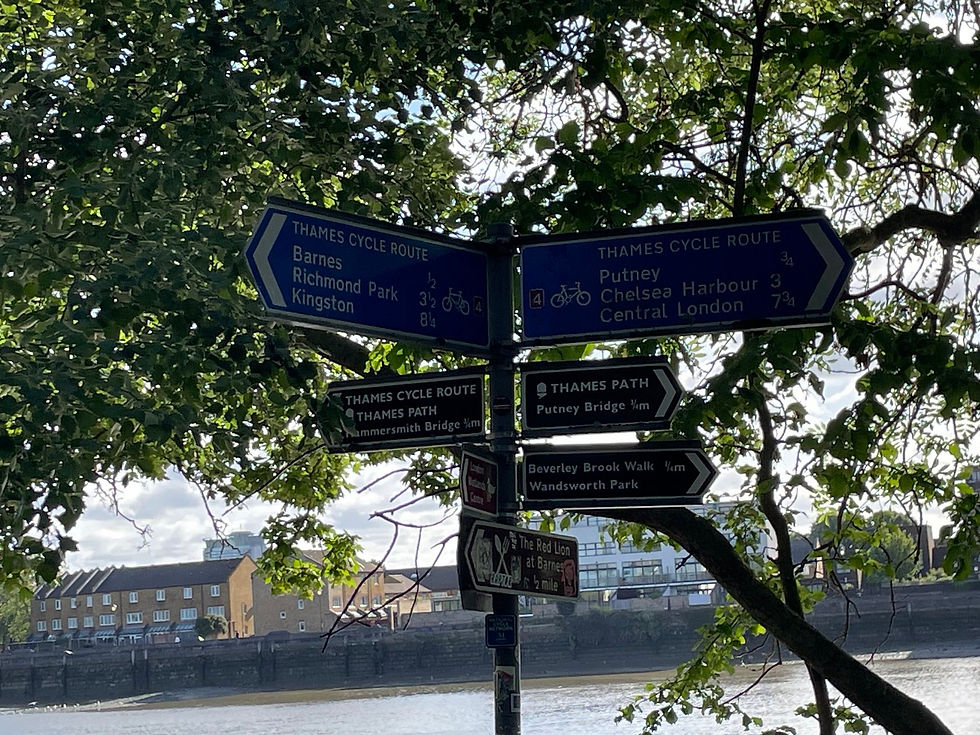
Turn left and continue walking beside the river until you reach Hammersmith Bridge.
This is roughly the halfway point and there are several pubs and cafés on either side of the bridge where you can stop for refreshments. If you would prefer a shorter walk, buses from the Castelnau side of the bridge will take you back towards Barnes Village or Barnes Station.
If you continue on, walk underneath the bridge and contine along the towpath for approximately a mile.

Opened in 1887, Hammersmith Bridge is one of the world's oldest surviving suspension bridges. The bridge has been closed indefinitely to traffic since April 2019 after cracks were discovered in the bridge's pedestals.
As you approach Barnes once more, you will see Leg O’ Mutton Reservoir on your left, home to an impressive range of wildlife. If you would like to extend the walk, the perimeter nature trail is approximately one mile (1.6 km) long and offers excellent views across the reservoir and bird sanctuary.

From here the Thames Path and the road will now merge, continue until you reach the small roundabout (there is an option here to carry onto Barnes Bridge Station if you want to slightly shorten the walk).
Cross over into Barnes High Street, where you will find an abundance of coffee shops, pubs and cafés, as well as an M&S Foodhall and Sainsbury’s for refreshments before your journey home.
Continue along the High Street until you reach Barnes Pond. Make sure to say hello to the resident swan couple. As I write this, the female swan (pen) is nesting on the central island awaiting the arrival of her cygnets, so she is not visible in the photograph below, but Dad (cob) is standing guard nearby.

Barnes Pond with anxious dad waiting for his brood to hatch.
Turn right onto Station Road. On the corner stands Essex House, home to a popular farmers’ market every Saturday morning. Continue along Station Road to return to Barnes Station.
I hope you enjoy this charming walk, and if you walk this route, I would love to hear about it.
Tanya x
Comments