Homemade Kombucha

Updated: 9 minutes ago

A simple guide to brewing and flavouring your own kombucha
If you have never made your own kombucha before, it can seem a little daunting at first, but it's actually surprisingly simple.
You start with sweetened tea, a SCOBY and some starter liquid, then leave the culture to work its magic.
Once you've made your first batch, you can enjoy it as it is or give it a second fermentation with fruit, herbs and spices. This is where I think the fun really starts, as you can experiment with different flavours and combinations depending on what you enjoy or what's in season.
For this batch, I'm trying three flavours: Wild Blackberry & Apple, Chilli & Honey, and Lemon & Ginger.
Equipment
You'll need:
A clean glass jar, approximately 1.5 - 2 litres
Kettle
Measuring jug
Wooden or silicone spoon
Clean muslin, kitchen or paper coffee filter
Elastic band
Clean pressure-safe fermentation bottles, ideally flip-top bottles designed for carbonated drinks
Funnel, useful but not essential
I prefer to use glass, wood or silicone when handling my SCOBY and avoid unnecessary contact with metal.
Cleanliness is important when fermenting, so make sure your jar, bottles and equipment are thoroughly clean before starting.
Ingredients
Makes approximately 1 litre
1 kombucha SCOBY
100ml starter tea, the liquid supplied with your SCOBY or reserved from a previous batch
2-4 black or green tea bags
60g granulated white sugar
1 litre water, filtered or boiled and cooled (uk)
A note on the sugar: It might seem like a lot, but don't be tempted to leave it out. The sugar feeds the yeast and bacteria during fermentation. Around 55–80g per litre is a typical starting range, so I use 60g.
What is a SCOBY?
SCOBY stands for Symbiotic Culture Of Bacteria and Yeast. It's the culture responsible for transforming your sweet tea into kombucha.
You can buy one from kombucha suppliers, some health food shops or online, or you may be lucky enough to have one gifted to you by another kombucha maker. Make sure it comes with a small amount of starter tea (the original liquid that the SCOBI comes from), as this acidic liquid is important for getting your first fermentation underway.
As you continue brewing, you'll often see a new layer forming across the surface. This is commonly called a baby SCOBY. Over time, the layers can be separated and used for other batches or gifted to friends, which is one of the lovely things about making your own.
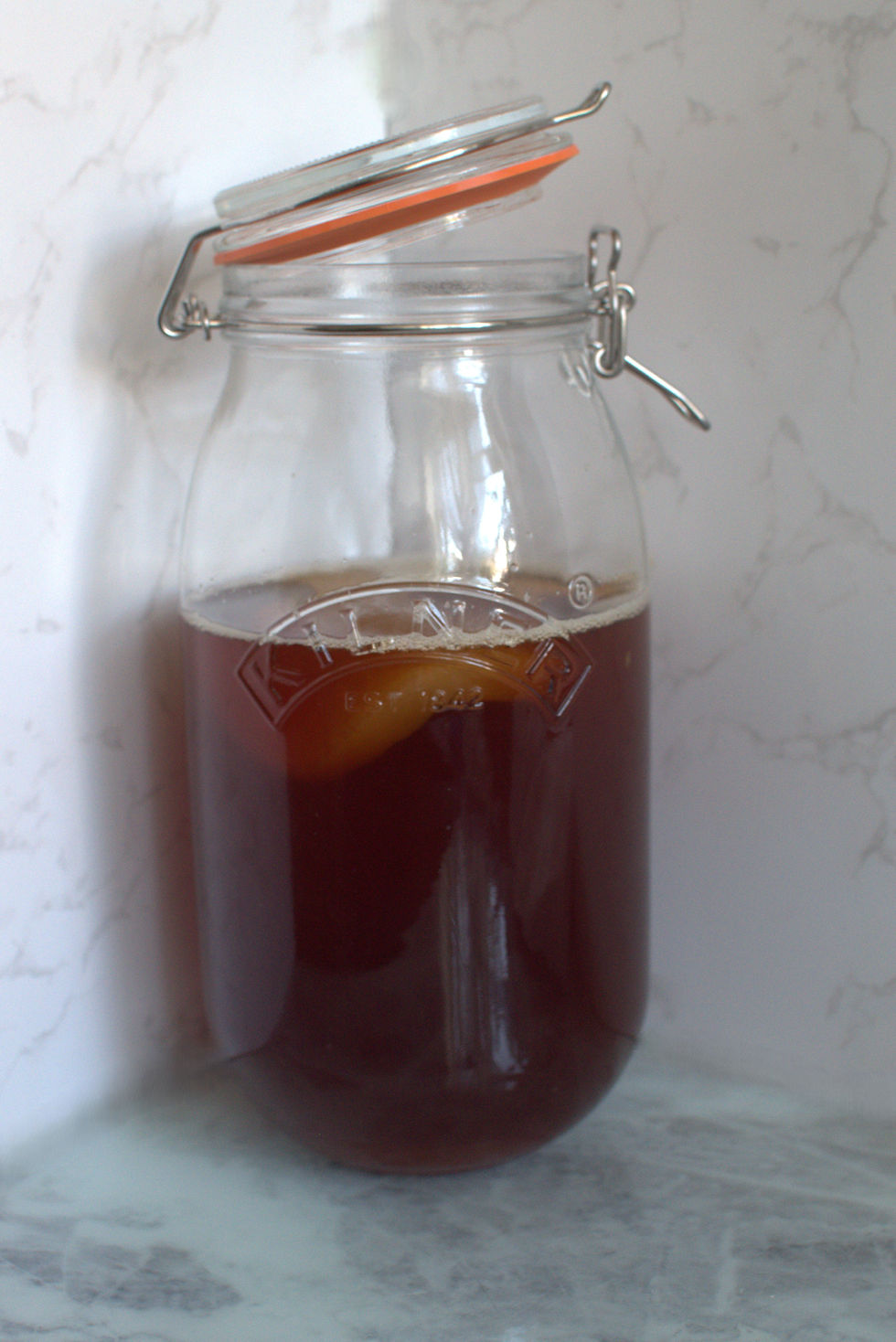
First Fermentation
1. Make your sweet tea
Boil the water. Add the tea bags and sugar and stir until the sugar has dissolved.
Allow the tea to steep for around 10-15 minutes, then remove the tea bags without squeezing them.
2. Cool completely
Leave your sweet tea to cool completely to room temperature.
This bit is important. Don't put your SCOBY into hot tea because excessive heat can damage the culture.
3. Add the SCOBY
Pour the cooled sweet tea into your clean glass jar.
Add your starter tea, then gently add your SCOBY.
Don't worry whether it floats, sinks or sits somewhere in between.
4. Cover
Cover the top of the jar with a clean breathable cloth or strong kitchen towel and secure it firmly with an elastic band. This allows airflow while keeping out dust and fruit flies.
5. Ferment
Leave at room temperature, somewhere out of direct sunlight.
I leave mine for around 7 days, then start tasting it. The longer you leave kombucha, the more tart and acidic it becomes, so taste is a better guide than following an exact number of days. A first fermentation of roughly one to two weeks is typical.
Once it tastes good to you, your first fermentation is complete.
Before You Flavour It...
Remove the SCOBY and set it aside and cover with your plain kombucha.
That's the starter tea for your next batch, so don't accidentally flavour or drink it!
You can drink the remaining kombucha now, but I like to give mine a second fermentation.

Second Fermentation
This is where you can have some fun.
Put your chosen flavourings into clean, pressure-safe bottles, add your kombucha and seal.
Fill the bottles about 2/3rds full rather than filling the bottle to the brim. Leave the bottles at room temperature for around 3-4 days to develop flavour and fizz, then refrigerate thoroughly. Fermentation continues inside a sealed bottle and creates carbon dioxide, so pressure can build. Don't leave sealed bottles fermenting indefinitely, it is common practise to burp your komboucha (briefly open and close the top of your bottle) to allow excess gas to escape.
My Three Flavours
These quantities are starting points rather than strict recipes. Part of the pleasure of making kombucha is finding the combinations you like.
Wild Blackberry & Apple
For approximately 330ml kombucha:
a handful of blackberries
2 tbsp finely chopped or pureed apple
I love the idea of using wild blackberries when they're in season. Just wash them thoroughly before using.
Chilli & Honey
For approximately 330ml kombucha:
1 or 2 small fresh chillies
1 tsp honey
Put the whole chilli into the bottle for a gentler infusion, or slice it if you want more heat.
I'd start with one chilli. You can always get braver with batch number two!
Lemon & Ginger
For approximately 330ml kombucha:
1–2 thin slices fresh ginger
1–2 tsp fresh lemon juice
Fresh, zingy and probably the one I would reach for when I want something refreshing in the morning.
Make It Your Own
There really isn't an need to stick to my combinations. Once you've mastered the basic brew, just experiment!! Try berries, apple, pear, peach, citrus, ginger, mint, herbs or spices, and combine them according to what you have available and what is in season.
Storage
Once your kombucha has reached the flavour and fizz you like, keep it refrigerated. Refrigeration dramatically slows fermentation, although it doesn't necessarily stop it completely. Open homemade kombucha carefully, especially highly carbonated fruit batches as you might get some spashback!
If you see fuzzy mould growing on your first ferment, rather than the normal smooth or stringy SCOBY growth, discard the entire batch and SCOBY and start again.
Why This Works – The 60Fit Approach
Kombucha is a fermented drink that can contain live microorganisms. While research into its specific health benefits is still developing, fermented foods more broadly are increasingly being studied for their potential role in supporting a diverse gut microbiome.
However for me, this isn't about kombucha being a miracle health drink. It's about finding enjoyable alternatives that fit into how I want to live now. Making kombucha gives me that, and I love that I can experiment with seasonal fruit, herbs and spices and make each batch a little different.
60Fit Tip
Save your starter before you start flavouring!
Remove your SCOBY and enough plain kombucha to cover the SCOBY and keep them together for your next batch. Once you get into the rhythm of brewing, one batch simply leads into the next.


Comments